“we are not hopeless enough”
Brazil as a display of our own failings
These are busy days in Argentina and in Latin America. Across the region, foreign interference from the United States has taken on a pornographic quality, replaying the Cold War years as farce. One country after another is adopting what gets wrongly called a “turn to the right”, and just when the last bastion of a more progressive option looks ready to fall, the Brazilian people put on a display of popular organisation, of defence of recent gains and of memory, electing Lula da Silva president for the fourth time in the runoff of Sunday 25 October against Flávio Bolsonaro.
In Argentina, meanwhile, the government keeps insisting on economic recipes that are dogmatic and tailored to the great powers, seemingly doing everything it can to go on suffocating the economy.
The trouble is that, even though the Brazilian elections show that governments who sell the country off can be beaten, here in Argentina we don’t seem to have anyone to beat them with inside the opposition leadership.
Thinking about ourselves and about Argentina
What was going to be a piece about artificial intelligence seen through Pope Leo XIV connected with some ideas I have been reading lately: power in Hegel and kindness in Byung-Chul Han. Luckily, though, both the recent political events and the sadness that has come over me from personal situations that echo the state of the country give all of this a bit more feeling and a thread to follow, and save it from being one more unreadable attempt at a philosophical essay.
Before I get to my central idea, though, I do need to lay out a few basic concepts as briefly as possible, without unfolding the Hegelian system or getting into an academic argument about the terms.
In his book Hegel and Power: An Essay on Kindness, Han sets out the nature of power in Hegel beautifully:
“Power is the capacity to continue oneself in another while remaining intact” (Han, 2022a, p. 27).
Power appears wherever the subject, in going out of itself towards the world and towards others, finds itself again. Power becomes a mediation that cancels differences. Which is why “power is beautiful because it produces the continuity of the same” (Han, 2022a, p. 28).
Against a first intuition: “power can be bound up with violence, but it is not founded on it” (Han, 2022a, p. 65).
“Violence, for the object, is something merely external that attacks or destroys it” (Han, 2022a, p. 64).
That is what makes it different from power, which is unifying. The object of power does not receive it as external violence; it coincides with that external will in the enjoyment of itself.
When he turns to love, the same elements soon reappear, since, as Hegel puts it: “Love can only arise towards what is equal to us, towards the mirror, towards the echo of our being” (Han, 2022a, pp. 72-73). The true essence of love lies in the possibility of finding myself in the other through the abandonment of myself (Han, 2022a, p. 64).
But if power is the will to continue oneself in the other, to become one with the other inside my own concept, what happens when I don’t want to make the other a means of my concept? What happens when we manage that instant of silence in which we let what is other come into us? Only a kind soul is capable of that.
That is why Han presents kindness as something “entirely different, which shines in spite of, or even thanks to, the absence of power” (Han, 2022a).
A radically opposite vision of love, one founded on kindness, rests on “being able to wait” for the other and on “letting be” until their essence unfolds. What we are talking about is “leaving the other in their own being” (Heidegger, as cited in Han, 2022a, p. 79).
Empty of power
Plenty of people will get annoyed at this, but why not think of ourselves as empty of power? In the end, each of us lives differently imprisoned by “the algorithm”, the reality built for each one of us, the matrix, where we only see what gives us pleasure and can choose to avoid whatever causes us pain. Meta stopped recommending political content on Instagram and Facebook by default in 2024; in 2025 it reversed course and now offers us a button to switch it off. What we see and what we don’t depends on an inscrutable discretion that, as our ration of freedom, seems to “leave us free to choose” to be a little less of a citizen every day and to ignore political reality altogether.
This reality tailored to our taste is very dangerous, because it hands us the full enjoyment of power: “the enjoyment of self is the fundamental trait of power” (Han, 2022a, p. 27), where we only see what keeps us docile, undisturbed, each of us getting our sedative on demand.
Isn’t each of us watching a world made to measure from our own screen? Everyone’s own continuation. Receiving an image of ourselves back from the world, we take pleasure in ourselves. We believe we have never been as powerful and as free as we are in the digital age. And in fact we have never been so short of power. Did anyone explain to you how your algorithm works? Careful: it may be someone else who is continuing themselves in you.
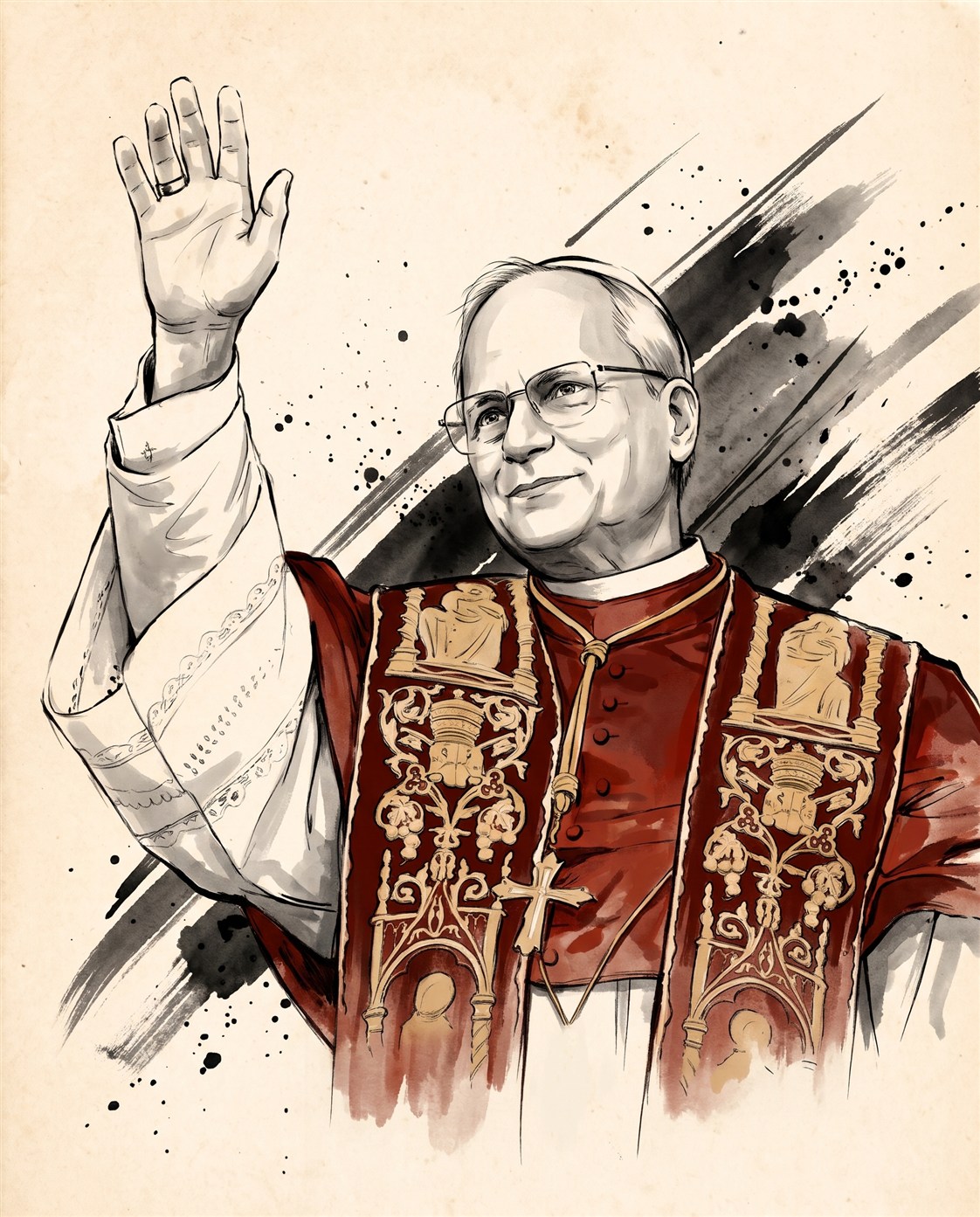
The Catholic Church is one of the actors taking a stand at a moment that badly needs it, under the leadership of Pope Leo XIV in Magnifica humanitas: technology “is not neutral, because it takes on the face of whoever conceives it, finances it, regulates it, uses it” (Leo XIV, 2026, para. 9). In the digital realm, the higher power “is not the State, but every large economic and technological actor that exercises de facto power over the conditions of common life” (Leo XIV, 2026, para. 71).
In days when time runs this fast and we cannot make out what it is we are building, the Pope reaches for the figure of the Tower of Babel to illustrate the project of power that part of the world’s economic power is trying to build as the horizon of humanity, or rather of post-humanism.
“Let us build ourselves a city and a tower with its top in the sky, and so make a name for ourselves. [...] Nothing will later stop them from doing whatever they presume to do, while they are one people, all speaking the same language.”
There is a project of common destiny under way that, instead of communion, chooses homogenisation (Leo XIV, 2026, para. 7). A project that feeds on the techno-optimism of part of the population, in search of the society of calculation, stripped of politics, empty of stories and of meaning. Spoiler: by the end of the film there is no room for everyone in Babel.
Blind faith in artificial intelligence makes invisible the mechanisms by which information reaches us, with no reasoning and no debate. With no ear for what is different and no room for kindness. AI is incapable of creating anything new: “it cannot give itself new facts” (Han, 2021, p. 42). What merely processes what is already given cannot think: “artificial intelligence does not reason, it computes. Algorithms replace arguments” (Han, 2022b, p. 59).
There is something that makes this power they hold over us more perfect still. That something is our “yes”, our voluntary submission or resignation. It is our consent that perfects power and turns it into domination, in the form of a command that meets obedience because whoever obeys accepts it as legitimate (Weber, 1922/2014).
There are many ways of saying “yes” to domination, and some of them make us believe we are doing the opposite. Outrage is one. Social media is the perfect setting for a politics of indignation. Each of us unloads our private worries there, spews hatred at other Argentines who think differently, and all that anger, which could be energy for organising and for building something in common, burns itself out in the gesture: a tweet, a story, a comment. It is the best way to go to sleep with a clear conscience and change nothing. (And along the way we hand over our data and publish it ready to be analysed as big data.)
In a BBC interview, Slavoj Žižek says that “we are not hopeless enough yet” (Žižek, 2026). Hope sometimes turns up as an excuse for leaving to others what we ought to be doing now.
From hopelessness to kindness
If we are this incapable, or this disabled, when it comes to exercising our power, then maybe a good first principle of counter-insurgency is to stop swimming against the current of anomie and to work at being a little kinder every day.
Kindness has a beautiful feature: unlike power, when it meets something small it does not overrun it. It lets it in, recognises it, gives it a place and a standing inside us.
In an increasingly apathetic Argentina we have to recover the capacity to cry for others and to embrace them. Kindness is the possibility of listening to a fellow citizen, to the person next to us, to the one who is sometimes under our own roof and suffering without our noticing, and to the one who has no roof and nobody to suffer alongside them. Today, while each of us looks at our screen, we drift further and further from the people closest to us. In doomscrolling, love of oneself becomes real and turns into an infinite isolation (Han, 2022a, p. 75).
Overwork for the sake of efficiency itself, fed back by artificial intelligence, assigns “greater worth to those who are more efficient and productive” (Leo XIV, 2026, para. 51), losing any sense of a human dignity that does not have to be proven. Every sign of otherness becomes an obstacle to efficiency. Above all we need to be able to recover a kind gaze towards the weak and the dispossessed.
From kindness to organising
Once the kind gaze has been recovered and the road of outrage abandoned, we need to find ways of acting again.
Leo XIV offers an image opposite to the Tower of Babel in order to imagine another way of building humanity: Nehemiah, who returns to a Jerusalem in ruins to rebuild its walls. And he does it the other way round from Babel: “He does not impose solutions from above. He calls the families together, entrusts each of them with a stretch of wall to rebuild, listens to their fears”, rebuilding the bonds before the stones (Leo XIV, 2026, para. 8).
“Come, let us rebuild the wall of Jerusalem, so that we may no longer be an object of derision! [...] They replied, ‘Let us be up and building!' And they undertook the good work with vigor. [...] The people worked with a will.”
In the rebuilding of the walls of Jerusalem every voice is needed, everyone deserves to be heard, and the wall of human dignity can only be built through the telling of what is different, never under the totalising logic of an inscrutable power that does not come from a people embracing its own diversity. On that basis the Pope calls on us to demand transparency in algorithms, independent audits in the AI race and clear tools that leave humanity somewhere to appeal, since we cannot let “a few actors alone steer the processes” (Leo XIV, 2026, para. 72). The fight for a kind AI is also a fight against homogenisation.
A way of setting organisation against homogenisation can start from the principle of subsidiarity in the social doctrine of the Church: “what individuals, families, local communities and intermediate bodies can do should not be absorbed by higher instances” (Leo XIV, 2026, para. 68).
I don’t know what that sounds like to you, but since I am far too political, it reminds me of the organizaciones libres del pueblo, the free organisations of the people, and the unidades básicas, the neighbourhood branches that make up the organised community behind any Argentine national project.
As we have seen, much of this isolation is reproduced by the algorithm and could be made worse by artificial intelligence. Maybe it is time to face this human urge to meet in person (the greatest risk of simulated bonds, the Pope warns, is not so much that we believe we are talking to a person, but that we lose “the very desire to truly seek out the other”, Leo XIV, 2026, para. 100) and to encourage spaces of popular organisation built on listening rather than on the lumpen-caudillismo of leaders who care more about going on leading their fifteen followers than about building something in common out of struggle. By lumpen-caudillismo I mean leaders with no training and no gift for leading, who would rather keep their closest followers, even if that makes any larger organisation impossible, than give up the sliver of power that feeds their ego. I am not taking aim at the caudillo as such: Argentine history had caudillos with popular legitimacy and a national vision of the whole, like Juan Manuel de Rosas. What gets in the way of organising is the person who plays at leading and only looks after their own little patch.
And let me not be misread. Verticalism is necessary and organisation is indispensable, because it is the only way of defeating time, above all these times stuffed with information and misinformation and crowded with disunity. Even so, that organisation has to recover kindness, put the human being back at the centre and push individual egos out to the margins.
Five ways to act in Argentina today
In defence of humanity, here in Argentina today, “no one is exempt from responsibility” and “each of us has a field of action of our own” (Leo XIV, 2026, para. 212). Here are the five ways of acting that Leo XIV proposes, read in the light of what I have been saying.
Disarm words. “Let us disarm words and we will help to disarm the earth” (Leo XIV, 2026, para. 214). The street and daily life have turned very violent; disrespect and contempt, for oneself and for others, are everywhere, and they come out of a larger social crisis. By offering a kind ear, listening to those who cannot speak and reaching out a hand through a kind word, we can do a great deal. It is worth remembering that “we have a real chance to contribute to the good every time we tell the truth” (Leo XIV, 2026, para. 214).
Build peace in justice. “There is no one who does not wish to be at peace, but not everyone wants to practise justice” (Saint Augustine, as cited in Leo XIV, 2026, para. 215). Even when it costs us and often takes more effort, every day we run into situations where we can get an immediate benefit at the expense of doing what feels more just. Peace at work, in the family, among friends and in every other space is built in those moments when pursuing justice makes us happy.
Take on the perspective of the victims. We may be living in one of those times when the spiral of silence weighs more heavily than ever. Hundreds of times a day we keep quiet in the face of injustice, simply because nobody else is speaking up. We keep our digital public image as bland as possible so as not to make anyone uncomfortable, so as not to say anything that might offend anyone. Some people even create “finstas”, a place to be a little less fake than on the main account without staining it. Justice, goodness and the faces of the victims are often not aesthetic. The truth does not always find a way of being said in the most politically correct manner. “There are situations in which, if we are to remain human, we must set hesitation aside and take sides” (Leo XIV, 2026, para. 216).
Cultivate a healthy realism. The fact that we are watching political idealism and its institutions fail, and fall short of guaranteeing peace in the world and an orderly political life together, should not throw us into a realism of resignation. We have to accept the rawness of power and of interests as a first step towards each of us having some effect in our own communities, with peace as the compass. The challenges we face clearly call for new and more realistic institutions with a view to protecting humanity, which also means being able to defend it.
“we all went back, each to his own task at the wall [...] each did his work with one hand and held a weapon with the other.”
Relaunch dialogue. Against the unison of the always-the-same, we have to set the chorus of what is different. Learning to lower our guard and to cut down our own contribution to everyday violence is a way of emptying ourselves and opening up kindly to others. “If we experience a genuine encounter with the other, the different one, the foreigner, the migrant, it becomes […] far harder to imagine war” (Leo XIV, 2026, para. 220). A nation of identical people sounds pretty boring next to a community organised around respect and around love for the person who doesn’t necessarily think the way I do.
The power of kindness is in each of us. “To each belongs a stretch of the wall” (Leo XIV, 2026, para. 13): the club, the neighbourhood association, the union, the parish, the student centre. While the leadership is not up to the task, the work starts close to home. That work will bring better times to the extent that “time is greater than space” and that “giving priority to time means being concerned about initiating processes rather than possessing spaces” (Francis, 2013, paras. 222-223). Nothing is lost where two or more people can get together to build something founded on love.
Works cited
Francis. (2013). Evangelii gaudium: On the proclamation of the Gospel in today’s world [Apostolic exhortation]. Libreria Editrice Vaticana. https://www.vatican.va/content/francesco/en/apost_exhortations/documents/papa-francesco_esortazione-ap_20131124_evangelii-gaudium.html
Han, B.-C. (2021). No-cosas: Quiebras del mundo de hoy [Non-things: Upheaval in the lifeworld] (J. Chamorro Mielke, Trans.). Taurus. (Original work published 2021)
Han, B.-C. (2022a). Hegel y el poder: Un ensayo sobre la amabilidad [Hegel and power: An essay on kindness] (M. Alberti, Trans.). Herder. (Original work published 2005)
Han, B.-C. (2022b). Infocracia: La digitalización y la crisis de la democracia [Infocracy: Digitization and the crisis of democracy] (J. Chamorro Mielke, Trans.). Taurus. (Original work published 2021)
Leo XIV. (2026). Magnifica humanitas: On the safeguarding of the human person in the age of artificial intelligence [Encyclical letter] (1st ed.). Editorial Claretiana.
The New American Bible. (n.d.). Libreria Editrice Vaticana. https://www.vatican.va/archive/ENG0839/_INDEX.HTM
Weber, M. (2014). Economía y sociedad: Esbozo de sociología comprensiva [Economy and society: An outline of interpretive sociology] (J. Medina Echeverría, J. Roura Parella, E. Ímaz, E. García Máynez & J. Ferrater Mora, Trans.; J. Winckelmann, Ed.). Fondo de Cultura Económica. (Original work published 1922)
Žižek, S. (2026). Interview with Paddy O’Connell [Interview]. BBC Newsnight.
Quotations from Han, Weber and Magnifica humanitas are my own translations from the Spanish editions listed above.