Yes, this blog begins inspired by Byung Chul-Han.
The title of this first article already gives a lot away. For some time now I have been immersed in reading Byung-Chul Han. The author attracts both admirers and detractors, and I believe this is mainly due to two things:
First, anyone who reflects on and critiques our ethics and our way of living (or passing through life) will reap either hatred or praise depending on whether they disturb our foundations and comfort zone, or whether instead they echo our fears — showing us that we are not so alone when it comes to thinking about what is happening to us as a community.
Second, and more directly, because one of the diseases of our time is the need to have an opinion about and moralize everything, regardless of how little we know about a subject.
So I believe the first of these things makes Han worthy of being heard, while the second helps strip away the halo of dramatism surrounding his figure.
This is not literary criticism nor a book summary, but an attempt to reflect on recent thoughts in the light of Han’s philosophy, trying to borrow his ideas in the least brazen way possible. In the end, we are all the Salieris of someone’s Charly.
We don’t need rituals where we’re going
Rituals are to time what furniture is to a house. Just as things make space habitable, rituals make time habitable.
We are terrified of closing chapters. Our brain, atrophied by marginalist economic calculation, does not want to hear about chapters that close. Why? Why can’t I have the plasticity to activate and deactivate facets of my person like the lights of a Christmas tree switching on and off? The imperative of production demands that we always be available with total openness to change. We know that time is sacred, which is why we must eliminate from it every obstacle to its exploitation.
In modernity, life could be organized around certain spheres with greater or lesser degrees of definition, without being exempt from overlaps. Some of the most common are economic prosperity, professional career, family, beauty, health, and academic formation. These spheres had greater or lesser presence in people’s lives at different moments. We call those moments stages.
In postmodernity, however, we can no longer speak of stages but of verticals or lanes. All of them can happen simultaneously, some may never open, but what they must not do is close. The postmodern, globalized subject not only encounters limits in space but seeks to traverse time free of constraints. If stages do not exist, each vertical of development offers fertile ground for neoliberalism’s self-exploitation.
This severance of initiation and closure rituals not only empties individual time but isolates us from others, directly undermining the idea of community — of which we still have some childhood memories left.
Others slow down time
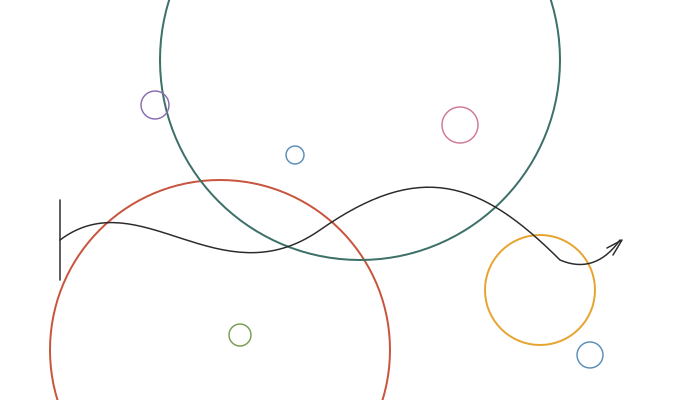
I imagine this analogy of how we move through the world with others. Our life is the line with a beginning and an end. The curve reflects our belief in the possibility of giving ourselves a destination. The arrows of others, we instrumentalize to the point of being able to think of them as circles. The circles (or the others) can intersect with our life or not. The first intersection is the entry of others into our life and the second is their exit. The distance between the first and second intersection can be wider or narrower, to the point of seeming as if both are the same point.
If a straight line is the shortest distance between 2 points, a line that oscillates constantly colliding (I use the verb colliding deliberately) against other objects is a sub-efficient line. Being with others takes time away from the narcissistic project.
Every encounter jolts and bends our line. The line stops pointing in the direction I want; the mere contact with others imprints a new force on our line that makes us wobble — careful not to end up spinning in circles. Past experiences combined with viral storytelling amplified by social media lead us to become impermeable and try to bend our trajectory when we face the risk of encountering a new circle. In the attempt to straighten the course of our line, we can trace perimeters that only lengthen the path and empty it of the beauty of being with others.
I say we instrumentalize others, trying to orchestrate their entry and exit times at our pleasure. The circles that burst into our lives make us uncomfortable, while we seek to intersect with certain circles with more distant orbits. We despair at not having control over other people’s orbits. Once past the first intersection, we maximize the benefit of the area generated between our lines. Some areas are larger or smaller than others; what matters is extracting maximum benefit and having control over the moment of closure — the exit of the other person from my life — after all, my life goes on and my project goes on. If we can’t control the entry point, at least we take advantage of the circumstance and wrap it up when convenient.
Sharing the pre-show of a concert with others is part of a whole, where the verb “I attended” in the first person singular loses its meaning. Sharing a beer or a coffee with someone special tastes better. Having conversations that last more than a thermos of mate is a treasure nowadays — not all that glitters is gold (Manu Chao). The non-productive ways of inhabiting time are among the few things that can split narcissistic individuality like lightning and make us part of something larger.
The worst of both worlds
This reflection will surely keep maturing and I’m not trying to be deterministic here, but in principle I believe that our current way of moving through time combines the worst of arrow-shaped time and time as eternal return — as Nietzsche spoke about it.
Arrow-shaped time (or history) has the problem of direction, rigidity and determinism. The history of eternal return or cyclical time, on the other hand, offers the possibility of giving each day whatever meaning we want to imprint on it. It is a rupture that allows us to take ownership of our destiny.
However, I believe that postmodernity presents an amorphous and undefined way of moving through time that oscillates between the two conceptions, trying to get the best of each without achieving either. Let me explain:
Today we laugh at subjects who remain tied to the linear vision of time, while we consider ourselves projects — owners and sole final masters of our destiny — without realizing that we daily impose on our lives equally conditioning imperatives. Our case may even be more serious, since the motivations we assimilate as “our own” or “authentic” appear to us as more legitimate than those that come from outside or from others.
We reject the idea of linear time. Nobody can tell us that a chapter is closing, that we are too old for something, or that something “is over.” We consider these violent intrusions on our individual freedom. We reject that negative violence without noticing the positive violence we build day by day repeating the mantra of self-improvement.
What if the fear that life passes us by comes true?
The song “Los Dos” by Las Pelotas goes:
"When we walked together I remembered I was alive,
I could never have imagined that path was a river"
First of all, beyond its natural or artificial origin, a path is only a path from the moment a person walks it as such — meanwhile, the river is an accident of nature that precedes and transcends the human. However, a path is not only more predictable than a river, it can also be traversed in at least two directions (forward and backward), unlike the river, which not only has a force of its own but one that imposes a direction.
We fight so hard against the linearity of time that we live “playing dumb” about death, not letting stages die, not letting parts of ourselves die. Sometimes, for the new to finish being born, you have to help it by killing the old.
It is easier to be a Frankenstein of additions of everything we once were than to ask ourselves in which chapter of our story we are.
So what do we do?
- Talk to that friend and repair that friendship.
- Take your grandmother for a walk.
- Organize the get-together with your old classmates that never happens.
- Gather a group of people who share your values to build something together.
- Get together and listen to someone who doesn’t share your values.
These are just a couple of quick ideas — and if you made it this far, I’d love to know what comes to mind for you.